
In the wake of Christopher Nolan’s ambitious film “Interstellar”, there is a lot of internet content out there over-analyzing the plot, themes, and overall theatrical experience of the movie. Plenty of words are wasted (or not?) discussing how this film fits into Nolan’s overall ouvre and how it compares to some of his other ‘heady’ sci-fi-fantasy works like “Inception” or even the “Batman” films.
Unfortunately, there is a lot less acknowledging what to me makes it a fun, but shallow theater experience: the lack of any consistent, accurate or complex science underpinning the actions in this film.
I’m not sure how to order this and I loathe listicles, but here are some scientific issues I had with “Interstellar.”
I also want to refute the oft-cited axiom “It’s Just a Movie!” which people throw out. And of course, nothing ruins good entertainment by annoyingly pedantic, party-pooping nerds who pick apart trivial aspects of a film and pontificate so as to prove something to others (and their insecure selves).
However, Christopher Nolan is not Michael Bay. He aims to make high-quality, important films, and I believe he really is an excellent filmmaker. “Interstellar” is an incredibly ambitious movie and in the promotional material Nolan has taken great pains to link this film to “real” science and the consulting work of Kip Thorne, a theoretical physicist who has done a lot of work with “wormholes” (but not plot holes). A lot of people are going to see this movie, and the expectations are that this movie is MORE than your typical dumb summer popcorn flick—that’s why it’s coming out in Oscar season! It has the ability to shape or impact the way a lot of people think about issues regarding space travel, funding NASA, climate change and even the way we design our robots in the future (the boxy hydraulics of the robot “TARS” is possibly the best thing about this film).

Also, the fact that a film with only surface-level, and inaccurate, usage of ‘science’ is considered to be unusually weighty or complicated for the typical theatergoing audience is disappointing. Is America’s public this science illiterate? Probably, and that’s a bad thing.
Without further ado, here are the problems I had with this film’s depiction of science
WARNING: SPOILERS AHEAD
Wormholes are NOT real

Even Kip Thorne would admit that these extraterrestrial bodies, which are so convenient for space and time-travel movies, are entirely theoretical. They are basically a way to achieve all the benefits of a black hole without any of the drawbacks (namely, being crushed and spaghettified); it could be possible to manipulate space-time in such a way that vast interstellar distances can be covered on time scales that make sense for humans.
The idea that Thorne’s consultation with filmmakers was anything more than a way for the Nolans to interview a really cool scientist is kind of offensive. No important scientific relavations or understanding was necessary, beyond the depiction of ends of a wormhole as spherical rather than two-dimensional. This concept, however, has been around for at least 20 years, if not longer. And it’s all theoretical.
Scientists have never found evidence of anything resembling a wormhole in outer space. And at that this point they don’t expect to.
Unfortunately, wormholes are about as relevant to real science as designing a time machine. Time travel, particularly into the future, is a scientifically relevant concept, but time MACHINES are a construction of the human imagination. As are worm holes and all similar space-bending phenomena.
Speaking of worm holes…
Somehow all these hours speaking with Kip Thorne, and the Nolans missed a critical component of these wormholes: they produce an ENORMOUS amount of gravity. A wormhole near Saturn would totally fuck up Saturn. You can’t just get a nice space bubble like what we see in the film. Full disclosure: I found out about this reading Slate’s article on the film’s astronomy mistakes here. http://www.slate.com/articles/health_and_science/space_20/2014/11/interstellar_science_review_the_movie_s_black_holes_wormholes_relativity.html
Black Holes are a bitch as well:


Black Holes crush everything that approaches well before even reaching what is known as the “event horizon”, the actual ‘point of no return’ where not even light can escape. You cannot just dive down into a black hole (as if you were spelunking) any more than you could stick your finger into a tornado. Most black holes are also surrounded by intense radiation and emit deadly stuff like gamma rays which would fry you if you got too close. Your charred remains might be able to squeeze down past the event horizon, but nothing resembling an astronaut or his spaceship. Past the event horizon it is a one-way ticket to the “singularity” at the center where all matter is condensed into a tiny point of near infinite density.
To date, no film or story has really figured out how to overcome the problems of approaching (or entering) a black hole without taking some intense creative licenses, most of which are fantastical (read: non-science) at best and ignorant at worst.
In “Interstellar”, Matthew Mcconaughey waltzes into the black hole like it’s the Lincoln Tunnel. Yes, he has to eject from his spaceship but once he does he’s basically swimming around in there until he reaches…a lot of nonsense involving yet another misuse of the word “tesseract”, which in science means “a ‘cubic’ representation of four-dimensional space in three dimensions” but in film it means a box full of magic because screenwriters apparently don’t know how to read science textbooks.
You also cannot extract anything from a black hole. At the end of the film Matthew Mcconaughey has successfully exited the black hole (through more movie magic) and it may require infinite viewings to appreciate how and why this happens, but part of the ominous mystery of black holes is the way they obliterate matter and information in such a total, profound way.
Black Hole Accretion Disks Need to be Fed by Something (like a nearby star)
The film’s depiction of a black hole is somewhat unique and very much beautiful, but it is also missing a critical component; a feeder for the accretion disk.
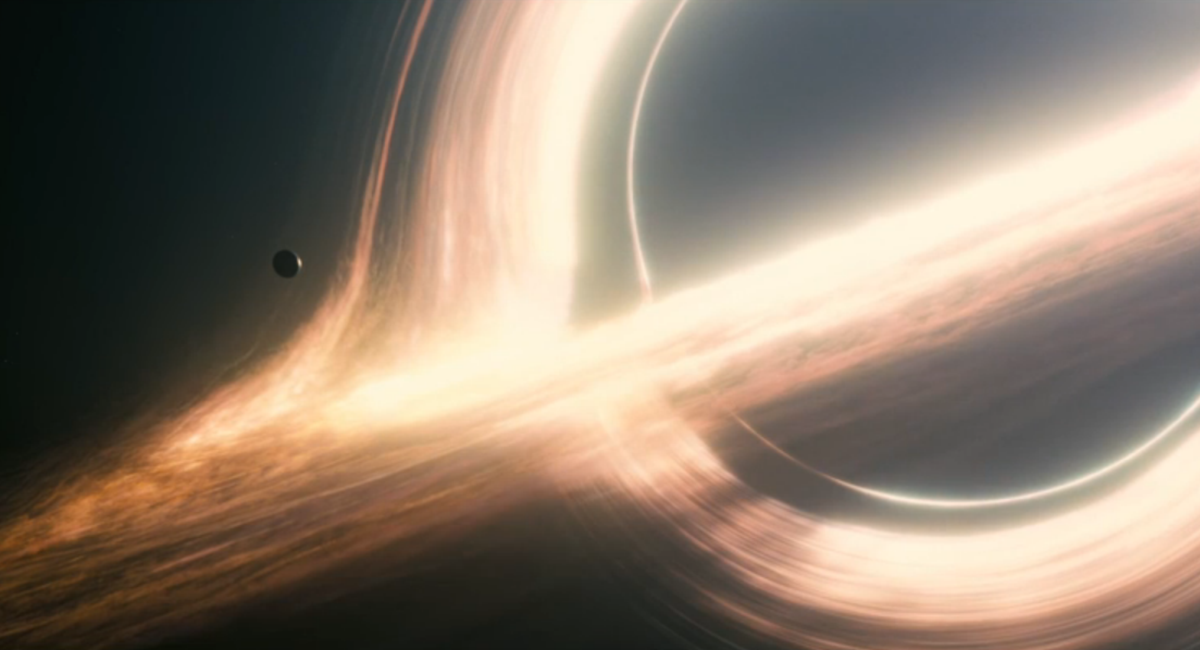
In the film, the black hole looks a lot like a trippy version of Saturn: a ring of light surrounds the dark center, and it also bends up and over the black hole as well. All that material is a realistic interpretation of what’s called the “accretion disk”, the superheat spinning particles of matter which are getting sucked into the black hole (and the brightness comes from the energy which is created when matter takes the final leap inside-radiation as a byproduct of the “equal and opposite reaction”). However, to have such a bright and spectacular amount of matter diving into the black hole, there needs to be a SOURCE! Black holes do not pluck matter from the ether.
A lot of black holes telescopes have found are just that: black holes. They block the view of surrounding stars and space. There is not dazzling light show around them. The ones that look like this typically are the ghosts of a BINARY star system (just like Tatooine!); if/when the older star of a pair dies and collapses into a black hole, then the gravity from the black hole begins to pull matter away from the sister star and thus creates this beautiful “accretion disk.” It would look like this:

What’s strange is that this would not have been difficult to portray in the film. The planets on other side of the wormhole have to orbit a star (not a black hole) in order to have night/day cycles or to draw in energy necessary for life (or even exist), otherwise these planets would not have been good prospects for the astronauts to repopulate with people. My only cynical guess is that the filmmakers thought this depiction would be more beautiful.
The distances to these objects would still take years to arrive at.
The film starts out by making a big, an accurate deal, of space travel. Future space travel has advanced enough, but only to take travelers from Earth to Saturn in two years. However, once they get through the wormhole, the distances between the celestial bodies becomes trivial. Time is wasted and accrued through inaccurate plot devices regarding the black hole and time dilation on the surface of the first place they visit (the one with crazy tides).
For a planet to be affected by the black hole with massive tides but not enough force to actually rip apart the planet itself, it would need to be quite far. I do not know enough to be able to give actual numbers, but I’m guessing something along the lines of several AUs (the distance between the earth and the sun). Probes take several months to a year to reach the sun, so just like the trip to Saturn, planet-hopping or black-hole hopping ought to take years, if not decades. I do not understand why the film makes attempts at accuracy in the first hour of the film when we are in our solar system, but then disregards the rules of space travel once the characters have reached another galaxy.
Problems With Time Dilation/Relativity
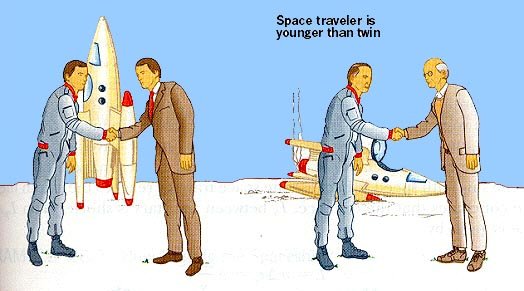
This movie is a mess when dealing with issues of relativity and how time moves faster or slower depending on where you are. Usually when dealing with this problem, the issue is that interstellar astronauts are travelling at speeds so close to the speed of light that time actually moves slower for them than it does for “stationary” people on Earth, hence the “twin paradox” in the picture above.
The wormhole which allows the astronauts to travel to new planets is integral to the plot, but it’s also quite a cheat, considering the barrier to space travel is the unfathomable distances between objects. Also, the wormhole device prevents the astronauts from having to travel at absurd, unscientific (read: “hyperpace” or “warp speed”) rates to get to where they need to be. This means that while traveling in space, the time dilation effects are not significant. Once again, I will expose my ignorance to precise numbers, but the astronauts in this film are traveling at a tiny tiny fraction of the speed of light and it’s hard to conceive the time dilation effects as being more than a year or so difference at most between them and Earthlings (and that’s being generous).
To try to solve this problem, the Nolan brothers tried to use the black hole’s gravity and explain that on the first planet, the effects of the black hole cause time at the surface to occur so bizarrely that an hour on the planet is seven years in space. In the link to the Slate article, Phil Plait explains that for this to happen, the planet would actually have to be at the SURFACE of the event horizon, which as I said above (and he says this as well), contains conditions where nothing, especially a planet, would remain intact.
So the key plot development involving Matthew Mcconaughey’s abandonment of his grown-up children is scientifically plausible but not via the means achieved in the story itself.
Other minor details:
Other internet publications have made note of the following scientific inconsistencies, which are somewhat trivial but include: the lack of identifiable fuel sources on the spaceship, the inconsistencies with gravity on the planets they discover, the “Endurance” docking procedure, the explosion in space, the radio communication inside the black hole, etc.
This concludes Part One. In Part Two I will discuss the scientific problems the film has related to climate change and crop failure. And then maybe I will discuss a bit more why any of this matters.

 Culture Time